Cutting Medical Insurance Costs in Half with AI and Blockchain

Every now and then someone announces they’re going to shake up the insurance world. Usually it’s an app. It’s built from scratch, most of the time powered by AI, maybe running on a blockchain. Then comes the promise that makes everyone lean in: this dusty, old-school industry is about to be dragged into the twenty-first century! And your premiums? Cut neatly in half. It’s tempting, compelling. But it’s also worth asking the obvious question: is it actually possible or is it just very good marketing?
- Is insurance an overpriced and old school industry?
- Why insurance is strictly regulated
- Where your insurance premium actually goes
- Technology can't modernise the product
- The blockchain insurance startup
- Where innovation in insurance actually goes
- Case Study: Lemonade's Promise
- The bottom line
- F.A.Q. Frequently asked questions
Is insurance an overpriced and old school industry?
Note: this article builds on our earlier publication about why insurance is regulated. Worth reading first, as the two go hand in hand.
Insurance might look like it’s stuck in the past. Forms, questionnaires, waiting periods, providers that seem decades behind your banking app. So why hasn’t anyone simply modernised it? And why hasn’t any tech company done it better and cheaper? Established insurers have already digitalised, automated and streamlined most of what a startup would build. Which raises these questions:
- If the market is this competitive, why does the innovation feel so slow?
- Why don’t the premiums get any lower?
Why insurance is strictly regulated
Some people say insurance moves slowly because the industry has lots of strict rules in order to keep new competitors out. This lets the big, well known companies stay safe and comfortable without having to fight for customers.
But the reality is quite different: the rules exist to protect you, not the insurers. Insurance is a promise: you pay today and years later the company may have to pay for your cancer treatment, a major surgery or an accident abroad. Anyone can make that promise. So the rules such as licensing or capital requirements exist to make sure the company can actually keep it.
A startup with a great app but not enough money in reserve can be dangerous to you. If a serious claim lands and the money isn’t there, you’re the one left with the hospital bill. No matter how pretty and user friendly the app is.
This is the first reason insurance can’t modernise the way other industries do: a promise can’t be revised later. In most software and tech markets you can launch an imperfect product and fix it later. Insurance can’t work that way, because a policy is only as good as the insurer’s ability to pay a large claim ten or twenty years from now. A buggy app can get patched but an underfunded insurer just fails you when you need it most. That’s why regulated markets have some standards and requirements to meet. And failsafe for cases when an insurer actually goes bankrupt.
Where your insurance premium actually goes
The second reason is that when you pay your premium, most of that money doesn’t even go into the insurance company’s pockets. It goes straight back out to customers as claim payments. In good insurance products, 80-90% or more of what you pay is used to cover other people’s claims within the same year.
That means the price of insurance is driven by the utilisation: how often people go to the doctor, how expensive the medical bills are etc. And that won’t change with a super innovative, lean, AI based blockchain insurance. The biggest cost factor is utilisation.
– Christoph Huebner, Insurance Broker
The EU’s insurance regulator, EIOPA, has reported claims ratios of around 84% for medical expense insurance. What’s left, so maybe 10-20 cents of every euro, has to cover everything else: staff, systems, marketing, sales and a safety buffer for years when claims come in unexpectedly high.
This matters for modernisation more than for pricing. When an industry’s costs are mostly administration and production, technology can transform it. That’s what happened to retail, media and banking. But in insurance, the overwhelming majority of the cost is the claim itself: medical care. There is simply very little “old system” left to optimise away.
Technology can’t modernise the product
Let’s imagine that a startup built an insurance company that ran on AI, had almost no employees and somehow spent nothing on marketing or administration. Despite all that, in the best case scenario, they could only cut that small remainder, not the 80-90% that goes to claims. Why? Because the main cost of insurance is not technology or bureaucracy… it’s real medical care. It’s how often people see a doctor, what hospitals charge, what medicines cost and what happens when someone develops a serious, long-term illness. No app can change any of that.
So new technology can only modernise the packaging around the product: paying claims faster, making sign-up easier, building better apps. All of that is genuinely useful, and it’s good that new competitors push old insurers to keep updating. But it only improves the experience around the product, never the product itself.
That’s exactly why when you compare international health insurers, their prices seem to be surprisingly similar. Different features, different strengths, different specialisations but nobody offers the same coverage at half the price. For a very obvious reason: everyone is anchored to the same underlying cost – claims.
The blockchain insurance startup
Christoph recently had a conversation with a medical doctor who wanted to launch a travel insurance product built on smart contracts with everything running on a blockchain. But to actually deliver everything he had promised, he ended up designing… a fairly classic insurance company. The blockchain ended up as a nice detail, not the game changer he imagined. Because that’s what the promise of insurance demands: reserves, claims management, regulations. The technology can’t replace any of it.
His claim:
This product was so good and so cheap that it would simply sell itself. Customers would spread the word, so no marketing budget needed. But again, that’s not how insurance works. A pool of a few hundred friends cannot carry the risk of a single severe claim. Insurance needs scale to function, and scale requires investment in distribution and customer acquisition. No insurance in the world sells itself. This is not something even the smartest technology can change. Because insurance is not a lifestyle product everybody wants and talks about.
Where innovation in insurance actually goes
It’s not that innovation is pointless. It’s that it gets steered into different places than people expect. Instead of reinventing the product, innovation in insurance shows up as:
- faster claims settlement
- smarter fraud detection
- more precisely priced risk
- digital-first customer service
- stronger negotiations with hospitals
That’s exactly the innovation a competitive market already rewards. Established European health insurers now offer apps, telemedicine access and paperless claims that would have sounded like science fiction fifteen years ago. The market does improve over time. It just delivers the improvements as better service rather than a fundamentally different product, because that’s all the underlying mechanics ever allowed.
Case Study: Lemonade’s Promise
Founded a little over a decade ago in the US, Lemonade made its mission to disrupt insurance as we know it. It ticked every box on the startup checklist:
– built from scratch
– powered by AI
– nice looking app
Even people in the European insurance industry watched it closely. If Lemonade could pull it off in the US, who would be next? But what does Lemonade actually sell? Household insurance, renters insurance, pet insurance, car insurance – short term, non-life products. Nobody seriously touches health insurance. There have been attempts, for example an Estonian company called Lyfery is pitching cheaper life insurance. The premise is “healthy living incentives” but if you look closer, you will see that it’s mostly a marketing gimmick in an already very competitive market.
So why can’t anyone crack health insurance? There’s reason for it. If we take car or household contracts as examples: they run for one year, then stop. If you file a couple of claims, the insurer will most likely decline to renew. The insurer never has to make a promise it can’t keep. Health insurance is the opposite: people sign on to plans they expect to rely on for decades, sometimes even for life. That’s a fundamentally different risk.
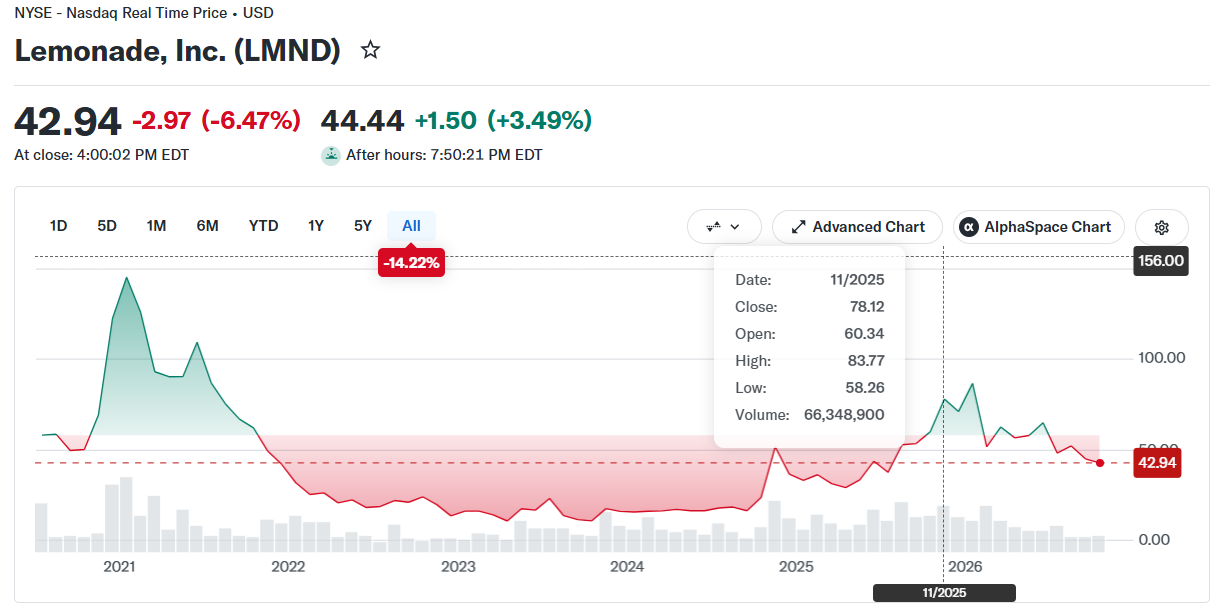
And Lemonade’s own performance? Just one glance at the stock chart tells you everything. Hype up front and cold shower after. That’s the reality: insurance is hard, promises are cheap and markets eventually notice the difference.
The bottom line
Insurance isn’t old-fashioned. The industry is already modernising everything technology could reach: claims handling, customer service, digital experience, telemedicine, negotiated treatment prices. What looks like an industry frozen in time is really an industry that is constantly working towards digitisation, because the money was never mainly going to old systems anyways. It goes straight back out to pay claims: the real cost of doctors, hospitals and medicine. That’s not an industry waiting to be disrupted. That’s a promise, working exactly as designed.
F.A.Q. Frequently asked questions
Can AI make insurance cheaper?
Sadly, no. Cutting admin and marketing to zero would still leave around 70-80% of the premium untouched, because that portion is the cost of actual medical treatment. Technology can streamline how insurance is delivered, not how much care costs.
Can insurance companies innovate anything?
Insurance companies are already innovating without you even noticing it. Digital claims submission, paperless policies, telemedicine access, apps for managing coverage and faster claim settlement are all innovations introduced by established insurers over the past fifteen years.
Insurance companies are already innovating without you even noticing it. Digital claims submission, paperless policies, telemedicine access, apps for managing coverage and faster claim settlement are all innovations introduced by established insurers over the past fifteen years.
Why are all insurance prices so similar across providers?
Because they’re all calculating the same thing. Every health insurer prices their products from the same foundations: how often people seek treatment, what doctors and hospitals charge and what medicines cost. Differences exist but these are usually different coverage levels, specialisations or service quality. Price stay more or less the same.


