Health insurance: The next price increases are coming

Have you noticed your health insurance premiums climbing year after year? You are not imagining it, and you are definitely not alone. Medical inflation is a reality that employers, insurers, and individual policyholders are all grappling with globally. Let’s unpack what is actually happening and what that means.
Understanding price drivers
It’s easy to assume that a premium increase simply means your insurer wants more money, but the reality is way different than that. Health insurance is a shared pool, everyone pays into it and when someone needs medical care, the money from that pool covers the costs. For that system to work, the amount going in (premiums people pay) has to roughly match the amount coming out (claims people make). When the balance shifts, premiums need to adjust to keep the pool sustainable. There are two main factors keeping it balanced:
Medical inflation: the cost of healthcare itself is going up. A hospital visit, a surgical procedure, a prescription drug, a diagnostic scan or a new treatment method such as personalised medicine adjusted to a patient’s DNA – all of these cost more today than they did five years ago.
Utilisation: how much people actually use their insurance. It can be influenced by a range of things: an ageing population naturally needs more care; growing awareness of mental health leads to more therapy visits; easier access to private clinics encourages more frequent consultations. On the other side, when people adopt healthier lifestyles and engage with preventative wellbeing programs utilisation can actually decrease.
What the numbers reveal
Every region in the world is dealing with elevated medical inflation, driven by the same structural forces: new technologies, expensive innovative drugs, straining public health systems and rising chronic disease rates. According to the 2026 Aon Global Medical Trend Rates Report, the global medical trend rate sits at 9.8%. APAC region stands out and not in a comforting way: the average medical inflation rate is projected at 11.3% – the highest medical inflation worldwide. Around one-third of markets including China, the Philippines and India, are seeing modest decreases thanks to a slight decline in utilisation and stronger uptake of wellbeing initiatives.
Thailand breaks PassportCard’s pricing models
Thailand’s medical inflation is so extreme that some insurers have been forced to fundamentally restructure how they price coverage for that country. PassportCard, an international health insurance provider, originally grouped Thailand within its broader Southeast Asia and Asia pricing zones. But Thailand’s medical costs became so distinct from neighbouring countries that the insurer had to single it out entirely into its own dedicated pricing tier. If you price Thailand using a blended regional rate, you either undercharge relative to the actual claims being generated or you overcharge policyholders in lower-cost neighbouring countries like Vietnam or Indonesia. By isolating Thailand, PassportCard could calibrate premiums to reflect the country’s genuine cost environment. That includes a dual-pricing system where foreigners are charged significantly more than Thai citizens for the same treatments. This isn’t unique to just one insurer. When a single destination’s medical inflation rises significantly, insurers in general have no choice but to respond with targeted measures rather than implementing regional increases. If you want a firsthand look at what a medical emergency in Thailand actually looks like from the inside, Christoph’s own experience navigating the Thai healthcare system offers a real perspective on why these costs add up so quickly.
BDAE Premium adjustments
Due to the continuing rise in healthcare costs worldwide, BDAE will be adjusting premiums for Expat Infinity effective 1 October 2026. This increase is accompanied by changes to the terms and conditions of the insurance policy with special arrangements for Thailand, Singapore and Hong Kong. These countries stand out with a very high standard of care, yet treatment costs there have been rising significantly for years. As a result, policyholders on the Basic plan under Expat Infinity will have to pay a 20% deductible for planned treatments at certain hospitals and medical practices in these three countries (excluding emergency and accident-related treatments).
Let’s get into the specifics. By comparing BDAE‘s current premium table with the new one (effective October 2026), we can see exactly how premiums are changing across age brackets and host countries:
| Age Bracket | Host Country | Monthly Premium (Oct 2025) | Monthly Premium (Oct 2026) | Increase (%) | Monthly Difference |
|---|---|---|---|---|---|
| 0–10 | Singapore | €160 | €174 | +8.8% | +€14 |
| 26–30 | India | €71 | €77 | +8.5% | +€6 |
| 46–50 | Thailand | €170 | €194 | +14.1% | +€24 |
| 51–55 | Hong Kong | €304 | €347 | +14.1% | +€43 |
| 56–60 | Japan | €215 | €254 | +18.1% | +€39 |
| 61–65 | Singapore | €408 | €522 | +27.9% | +€114 |
| 66–70 | Thailand | €312 | €399 | +27.9% | +€87 |
| 71–75 | UK | €624 | €799 | +28.0% | +€175 |
| 76–80 | Australia | €496 | €635 | +28.0% | +€139 |
| >85 | Singapore | €1,229 | €1,573 | +28.0% | +€344 |
A few patterns emerge:
The increase scales sharply with age: a 26-year-old in India sees an 8.5% bump (€6 more per month). A 71-year-old in the UK faces a 28% increase (€175 more per month, or €2,100 more per year). The older you are, the steeper the adjustment.
Higher cost zones amplify the effect dramatically: for context, a 61-65 year old in Singapore goes from €408 to €522 per month (an additional €1,368 per year). This reflects the reality that high standard healthcare markets (like Singapore, Hong Kong, UK or Switzerland) are where medical inflation hits the most.
The compounding effect is real: these aren’t just percentage points on paper. The youngest policyholders absorb a relatively modest increase but older policyholders in expensive healthcare markets will be faced with a significantly heavier increase.
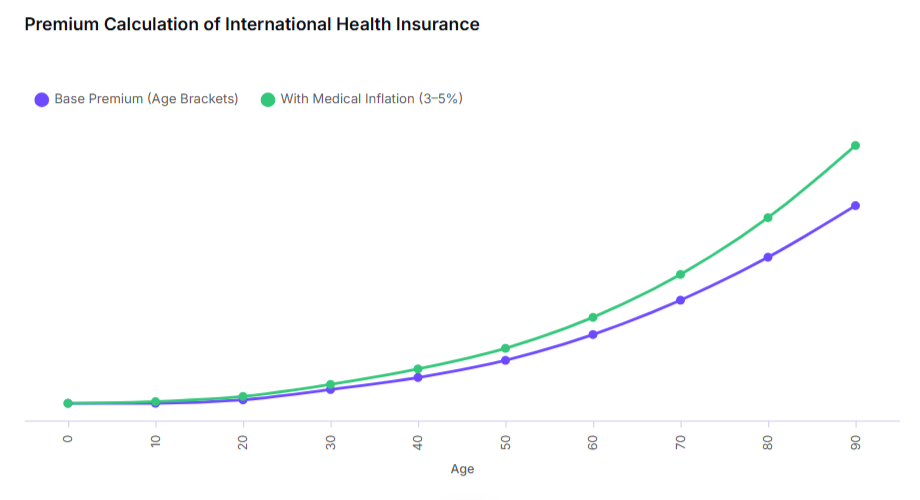
The above graph illustrates how international health insurance premiums develop over a lifetime. The lower line represents the base premium, which increases in steps as you move through age brackets. The upper line shows the same trajectory with medical inflation added (an average of 3-5% per year).
Why medical inflation is real and why premiums must follow
When the cost of medical treatments, pharmaceuticals and hospital stays rises, insurers face higher claims costs. Those costs are ultimately reflected in premium adjustments. This isn’t greed or mismanagement, it’s the basic mechanics of how insurance works. Factors such as the shift towards private healthcare (as public systems strain under demand), imported medical technologies exposed to currency risk and a rising chronic disease burden are driving up medical costs even faster than overall inflation.
”For HR and benefits leaders, managing medical costs remains front and centre for the year ahead. Even though inflation has abated slightly, utilisation is keeping claims high.”
– Daniel Teoh, Data and Analytics Consultant, Global Benefits for Aon in APAC
WTW identifies six key cost drivers that are at play across almost all regions:
| New medical technologies | Innovative diagnostic procedures, surgical methods, and modern therapies enable treatments that weren’t feasible years ago |
| Innovative medicines | New cancer drugs, personalised therapies, and GLP-1 preparations significantly increase costs |
| Weakening public healthcare systems | Public systems reaching financial/staffing limits, shifting services to private sector |
| Rising demand and operating costs | Higher staff, energy, material costs plus expensive medical equipment |
| Global supply chains and trade policies | Trade disputes and tariffs make medical products more expensive |
| Complex and chronic conditions | Cancer is the most expensive and fastest-growing diagnosis in insurance claims |
The long-term average you should expect for medical inflation is roughly 3-5% per year, with some years hitting harder, as 2025 and 2026 have demonstrated. Understanding this baseline helps you interpret annual increases and avoid panic when a sharper adjustment lands.
Don’t confuse medical inflation with ageing brackets
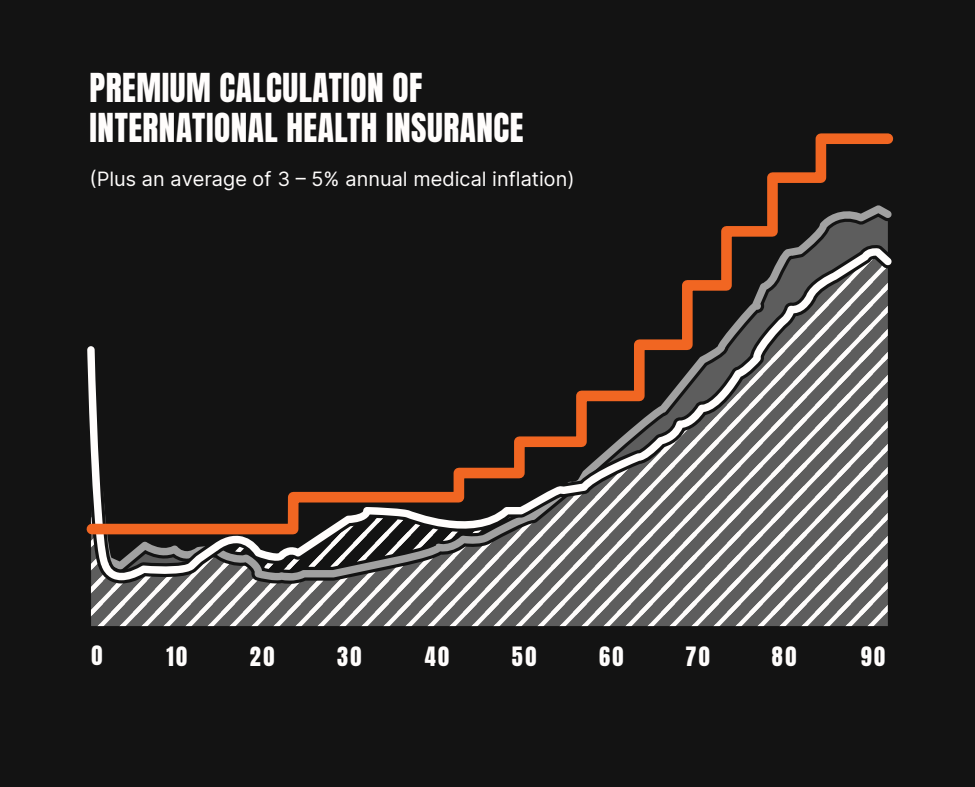
International health insurance plans don’t carry ageing reserves. Unlike some domestic schemes that smooth costs over time. This means the effect of moving into a higher age bracket should be transparent and known to you from the outset. If your premium jumps significantly and you can’t identify whether the increase reflects medical inflation, an age-bracket transition, or both, that’s a conversation worth having with your insurer. Clarity here is essential and it’s your right to understand the breakdown. Need some help with that? Get in touch with us, we always make age brackets an integral part of our consultation process, so there are no surprises.
Not all increases arrive simultaneously
The price adjustments hit across the board, but not all at the same time. Due to differences in insurance calculation methods, product structures and renewal cycles, providers adjust at different points throughout the year. This means that an increase with your current provider does not automatically mean that you should switch. Jumping to a new insurer simply because they haven’t yet applied an increase can be short-sighted as the adjustment will likely follow. The grass isn’t always greener, the price changes may just be on a different schedule. There are of course legitimate reasons to consider switching providers. If there is a wider underlying problem at your particular provider: poor claims handling, unsustainable pricing architecture or if your target destination presents specific challenges (for example Thailand), then a reassessment may be needed. But the decision should be based on a thorough evaluation, not an immediate reaction to a single renewal letter.
Final thoughts
For anyone holding international health insurance, understanding why premiums move is just as important as knowing by how much. The smartest approach combines realistic expectations with proactive engagement: understand your policy’s age brackets, differentiate between inflation-driven and structural adjustments, stay informed about upcoming changes like the premium adjustments.
Have questions about your recent premium adjustment? Want to understand how medical inflation is affecting your specific plan? Reach out! We’re happy to help you navigate the numbers and make confident decisions about your health coverage.
F.A.Q.: Frequently Asked Questions
What is medical inflation?
Medical inflation refers to the rising cost of healthcare services, treatments, and medications over time, driven by factors like new technologies, drug development, and increased demand.


